AI Book Writer
Plan the characters and the outline first, then write your book one chapter at a time with AI, edit every page, and finish with print and ebook files.
- Chapter by chapter
- Characters and outline first
- Print PDF and EPUB
One chapter of every book is on the free plan; the others need a paid plan or a credit pack.
What an AI Book Writer Does, and What It Doesn't
An AI book writer plans a book with you (premise, characters, chapter outline) and then writes it one chapter at a time, so every chapter knows what came before.
A single prompt can't hold a novel. Ask a chatbot or a one-shot generator for a whole book and you get a long summary that forgets its own characters by page twenty.
Story-AI's AI book writer works the way writers do. You settle what the book is about, who is in it and what happens in each chapter. Only then does the AI write, one chapter per request, reading the outline, the character sheets and what the earlier chapters left behind.
You stay in charge of every page. Each chapter lands in an editor where you can rewrite it by hand, ask the AI editor for a change and accept or reject each suggested edit, or add pictures. Regenerate a chapter and its earlier text is kept as a version you can restore.
When the manuscript is done, the same workspace reviews it, writes your blurb and keywords, makes a cover, and typesets a print PDF and an EPUB for Amazon KDP and other stores.
People also search for an ai book generator. The difference is the process: a generator returns one block of text, while an AI book writer keeps a plan and a memory for the whole book.
A chapter-by-chapter workspace
- A premise, characters and an outline before any chapter
- Every chapter reads the plan and the chapters before it
- You edit, regenerate or restore each chapter
- Review, cover and print files in the same place
A one-shot book generator
- One prompt, one long block of text
- No outline to check the story against
- Starting over is the only way to change direction
- Formatting and publishing are up to you
How to Write a Book with AI in 10 Steps
The same ten steps as the workspace, from an idea to the files a store asks for. You can stop after any of them and come back later.
- 1
Describe your book
Write a few sentences about the story, let the AI turn rough notes into a description, or import a Word draft you already started.
Free to type; 1 credit to write it with AI; a draft 1 credit per 3,000 words
- 2
Settle the basics
The AI suggests a title, genres, subgenres and a chapter count (1 to 100) in one of 30 languages. Change anything you like.
1 credit
- 3
Add the details
Audience, tone, writing style, plot devices, selling points and content warnings, plus an optional sample of your own writing for the AI to match.
1 credit
- 4
Create the characters
Up to 30 characters with 13 fields each: role, look, background, personality, motivation, conflicts, stakes, arc and voice.
1 credit per character
- 5
Outline the chapters
A synopsis and one card per chapter with its plot events, places, hooks and twists, character interactions and target length. Move, insert or rewrite cards.
1 credit per 4 chapters
- 6
Write chapter by chapter
Each chapter streams into the editor. Edit by hand, use the AI editor, add images; a regenerated chapter keeps its earlier text as a version.
1 credit per 500 words written
- 7
Review the manuscript
A book editor marks line edits, proofreading fixes and notes chapter by chapter, then writes an editorial letter. The first page is edited free as a sample.
5 credits per 1,000 words, once per book
- 8
Prepare the metadata
A blurb, a subtitle, 3 store categories, 7 keywords, the front and back matter, and a cover you generate or upload.
1 credit; a generated cover 2 credits
- 9
Typeset the book
Pick one of 5 themes and 8 KDP trim sizes, check the preview, then download a print PDF, a paperback cover with spine, an EPUB and an ebook cover.
Preview free; files 60 credits once per book, on Premium and up
- 10
Promote it
Social posts for five platforms, Amazon A+ content, a press kit and review requests, written for your book.
3 credits per piece, on Premium and up
A Real Book from the AI Book Writer, Unedited
One idea, run through the same steps and prompts as your books. Nothing below was rewritten.
We typed the idea below into the AI book writer and accepted every proposal, except that we cut the outline to 6 chapters to keep the sample short: the basics, 3 characters, the outline and chapter 1. Each character shows two of its 13 fields; each chapter plan shows its first sentence and opens to the whole plan.
The idea we typed
“A mapmaker's apprentice lives in a city whose streets rearrange themselves every full moon. She finds one street that never moves, and the people who live on it remember a version of the city nobody else does. When her master vanishes on the night of a moon that never rises, she has to chart the one place no map has ever shown.”
What this cost on the free plan
- Basics and details
- 2 credits
- 3 characters
- 3 credits
- Outline of 6 chapters
- 2 credits
- Chapter 1, 1,247 words
- 3 credits
- One AI editor request
- 1 credit
- Total
- 11 credits of 20
What the AI book writer set up
The Unshifting Meridian
Synopsis
In the labyrinthine city of Oakhaven, the architecture violently rearranges itself with every full moon, wiping the populace's collective spatial memory. Apprentice mapmaker Ondine Vane discovers the Still Meridian, an anomalous thoroughfare that never moves, inhabited by people who remember the city's lost history. When the scheduled full moon fails to rise and her master, Elias Calder, disappears into the frozen dark, the city begins collapsing into architectural stagnation. Ondine joins forces with Bramwell Finch, a Meridian lamplighter harboring an ancestral archive. Together, they discover that Grand Surveyor Corvus Kael intends to bind the city permanently into artificial, lifeless stasis using Calder's stolen meridian astrolabe, a process that will extinguish the city's living pulse and erase the Meridian's inhabitants. Evading Kael's civic enforcers, Ondine and Bramwell trace Calder's path into the Null Core—the uncharted epicenter where the missing moon has been tethered beneath the earth. In a climatic confrontation atop the subterranean lunar engine, Ondine deciphers Calder's living charts to dismantle Kael's iron anchors. Though Calder sacrifices his physical form to restore the celestial cycle, Ondine releases the moon back into the sky, preserving the living pulse of the city while securing the Still Meridian as an enduring bridge between fluid change and historical memory.
The characters
Ondine Vane
Protagonist · nineteen
Personality
Meticulous and stubbornly perceptive, Ondine possesses a quiet bravery paired with an archivist's compulsive need for order. She often retreats into observation rather than emotion, though a fierce loyalty burns beneath her measured exterior.
Motivation
To track down Master Calder after his sudden disappearance on the moonless night and preserve the cartographic truth of the shifting city.
Corvus Kael
Antagonist · early forties
Personality
Meticulous, uncompromising, and chillingly polite. He regards human sentiment as an inconvenient variable in an otherwise elegant civic equation.
Motivation
To capture the anchor-point of the Unshifting Meridian and force the entire city into absolute, permanent stillness, regardless of the memories or lives erased in the process.
Bramwell Finch
Ally / Street resident foil · early twenties
Personality
Quietly wry, observant, and intensely loyal, Bram carries the melancholic gravity of someone who mourns landmarks that vanished decades ago. He balances a scholar's fastidiousness with the physical daring required to leap between shifting alleys.
Motivation
To protect the fragile sanctuary of the Still Meridian from collapsing into the city's chaotic cycles and to prove that his people's forgotten memories are true history, not madness.
The outline
- 1
The Moon That Never Rose
Ondine Vane prepares the atelier's drafting tables for the expected monthly lunar rearrangement, mixing silver-gall ink and setting plumb bobs.
Full chapter plan
Ondine Vane prepares the atelier's drafting tables for the expected monthly lunar rearrangement, mixing silver-gall ink and setting plumb bobs. When midnight strikes, the expected celestial glow fails to appear, leaving the sky in unnatural, starless ink. Instead of the usual rhythmic grumble of sliding stone, the city shudders violently and groans to a dead halt. Ondine rushes to the private study of her master, Elias Calder, finding the room ransacked: drafting cabinets are pried open, vital boundary journals are missing, and an anomalous brass survey-pin is left driven through the central desk. Searching the premises, Ondine uncovers Calder's hidden cipher notebook, which references an uncharted geographic null-point. She hurries toward the High Bascule Bridge to view the skyline and spots Civic Orthodoxy wardens sealing off the lower wards under emergency protocols. Realizing Elias did not flee but was systematically targeted on this anomalous night, Ondine resolves to trace his last surveyed vector into the forbidden districts.
- 2
The Quiet Cobblestones
Evading the Civic Orthodoxy's perimeter patrols, Ondine navigates the fractured Guttering Quarter, where alleys have stalled mid-twist with cracked masonry suspended in air.
Full chapter plan
Evading the Civic Orthodoxy's perimeter patrols, Ondine navigates the fractured Guttering Quarter, where alleys have stalled mid-twist with cracked masonry suspended in air. Following Calder's cryptic azimuths, she crosses an invisible threshold onto the Still Meridian—the only street in Oakhaven that never migrates. The ambient tremor of the city abruptly ceases, replaced by the scent of ancient river silt and fixed limestone. She is confronted by Bramwell Finch, an agile lamplighter armed with an iron wick-trimmer and copper talismans. Bramwell recognizes Calder's apprentice crest and reveals that the street's residents are in a state of panic: the perpetual eclipse threatens to erase the fragile boundary that shields their immutable road from total dissolution. Bramwell takes Ondine into an underground archive hidden beneath a clockmaker's shop, where maps showing an unmoving, centuries-old version of the city are preserved. Together, they realize Calder's cipher points toward an artificial anchor planted beneath the city's founding bedrock.
- 3
Geometry of an Iron Will
Bramwell guides Ondine through the forgotten service tunnels beneath the Meridian to retrieve Calder's duplicate transit prisms.
Full chapter plan
Bramwell guides Ondine through the forgotten service tunnels beneath the Meridian to retrieve Calder's duplicate transit prisms. Their mission is interrupted when Corvus Kael and a detachment of wardens breach the lower vaults. Hiding above in a ventilation catwalk, Ondine watches Kael confiscate immutable stone relics and interrogating an elder archivist about Calder's final coordinates. Kael proclaims that the chaotic shifts are an urban plague, openly declaring his scheme to drive iron anchors through the city's heart to force perpetual geometric stillness. Rather than fleeing, Ondine takes a daring risk to infiltrate Kael's temporarily abandoned field office in the adjacent basin while Bramwell creates a diversion with chemical flares. Inside Kael's study, Ondine uncovers the chilling truth: Elias Calder was captured alive and dragged down into the Sub-Foundations, where Kael has constructed an engine to siphon the trapped moon's kinetic gravity into a permanent architectural lock.
- 4
Descent to the Blind Meridian
Reuniting amidst the smoke of Bramwell's distraction, Ondine and Bramwell escape through the Sunken Aqueducts, an abandoned subterranean waterway that shifts vertically when provoked.
Full chapter plan
Reuniting amidst the smoke of Bramwell's distraction, Ondine and Bramwell escape through the Sunken Aqueducts, an abandoned subterranean waterway that shifts vertically when provoked. Using Calder's ciphered notebook and Bramwell's ancestral knowledge of fixed water-marks, Ondine charts a viable path down into the tectonic depths. As they descend, the physical architecture begins defying conventional geometry, with staircases looping into non-Euclidean angles and shadows leaning toward an unseen gravitational center. They encounter spatial fractures where the city's amnesiac mist seeps through, forcing Bramwell to steady Ondine as fragments of her forgotten childhood emerge, linking her origin directly to this deep abyss. At the bottom of the descent, they reach the monumental vault doors of the Null Core, sealed by massive mechanical locks driven by Orthodoxy surveying gears. Before they can breach the entrance, alarm bells resonate down the shafts: Kael has anticipated their path and closed the perimeter behind them.
- 5
The Iron Engine of the Null Core
Trapped before the vault doors, Ondine uses Elias Calder's drafting compass to align the locking tumblers with the true coordinates of the Still Meridian, breaking the seal just as Kael's wardens close in.
Full chapter plan
Trapped before the vault doors, Ondine uses Elias Calder's drafting compass to align the locking tumblers with the true coordinates of the Still Meridian, breaking the seal just as Kael's wardens close in. She and Bramwell plunge into the vast cavern of the Null Core, an abyssal amphitheater dominated by an immense apparatus of brass rings and iron pylons. Suspended at the engine's center is a blinding sphere of captured lunar luminescence, tethered by iron cables that bleed its gravitational pulse into the bedrock. On the upper gantry, Corvus Kael holds the weakened Elias Calder captive, forcing him to calibrate the meridian astrolabe to lock the final gear. When Kael orders his enforcers to seize the intruders, Bramwell detonates his remaining lamplighter flares to blind the guards, allowing Ondine to scale the central scaffolding. Kael confronts Ondine directly, offering her a place in his eternal, immutable order. Ondine refuses, recognizing that stasis is slow death, and uses her bone folder to jam the astrolabe's primary drive gear.
- 6
The Ascendant Horizon
The jammed gear causes the lunar engine to buckle under catastrophic pressure, sending fractured gravitational waves through the stone chamber.
Full chapter plan
The jammed gear causes the lunar engine to buckle under catastrophic pressure, sending fractured gravitational waves through the stone chamber. Corvus Kael attempts to manually sever the release pin to force the lockdown, but Bramwell tackles him away from the platform, sending Kael falling into the grinding subterranean gears below. Realizing the celestial tether can only be broken by an anchor of living cartographic memory, Elias Calder integrates himself into the core mechanism, willingly dissolving into pure geometric light to release the moon. Ondine severs the final iron anchor cable with Calder's silver-gall stylus. The liberated sphere surges upward, blasting through the bedrock fissures and ascending into the night sky. The city of Oakhaven shudders as its fluid, living rhythm returns, while the Still Meridian remains intact, anchored by the collective memories of its people. Days later, Ondine reopens Calder's atelier alongside Bramwell, setting her ink and vellum to draft maps that honor both perpetual change and indelible history.
The opening of chapter 1
The Moon That Never Rose
The ink had to be ground before the bells of Saint Jude-in-the-Fray began their toll. It was an exacting business: soot of burnt walnut, three drops of ox gall to steady the tooth of the vellum, and pulverized silver suspended in distilled well water.
Ondine Vane dipped her horn spoon into the jar, her ink-stained fingers moving with the mechanical cadence her master had drilled into her since her tenth year. Along the wide zinc drafting tables, brass plumb bobs hung on lengths of oiled gut, poised inches above paper that had already been stretched, sized, and scraped clean. The pendulums drifted in lazy, infinitesimal arcs, stirred only by the draft seeping beneath the heavy shutters of the atelier.
"A city in motion is not an enemy, Ondine," Master Elias Calder had told her three nights ago, his spectacles shoved up into his wild crown of silvering hair as he examined her latest triangulation of the Copper Ward. "It is merely a restless sleeper turning in its bed. We do not cage it. We simply chart where its hands fall."
Tonight was the full moon. The twenty-eighth night. By all rights, the horizon beyond the attic dormer should have begun to whiten with the milk-pale rim of the rising sphere. With that rising would come the tide: the deep, grinding music of Oakhaven waking to change its skin. Basements would slide beneath butcher shops; colonnades would uncouple with the crack of breaking ice and skate three furlongs west; dead-ends would snap open into roaring avenues. By dawn, the city’s amnesiac citizens would step into their doorways, rub the sleep from their eyes, and accept the new geometry as though it had stood for a thousand years.
Only the cartographers remembered. That was the burden of the guild: to hold the memory the stone shook off.
Ondine wiped the lip of the mortar with a rag and glanced toward the glass cupola above.
The sky was the color of a wet slate shingle. Not a star. Not the faintest amber ember to announce the moon’s ascent.
1,247 words in the whole chapter, written on the free plan
One request to the AI editor
Request: “Make the opening paragraph more vivid without making it longer.”
Typeset with the Classic theme at 6 × 9 in
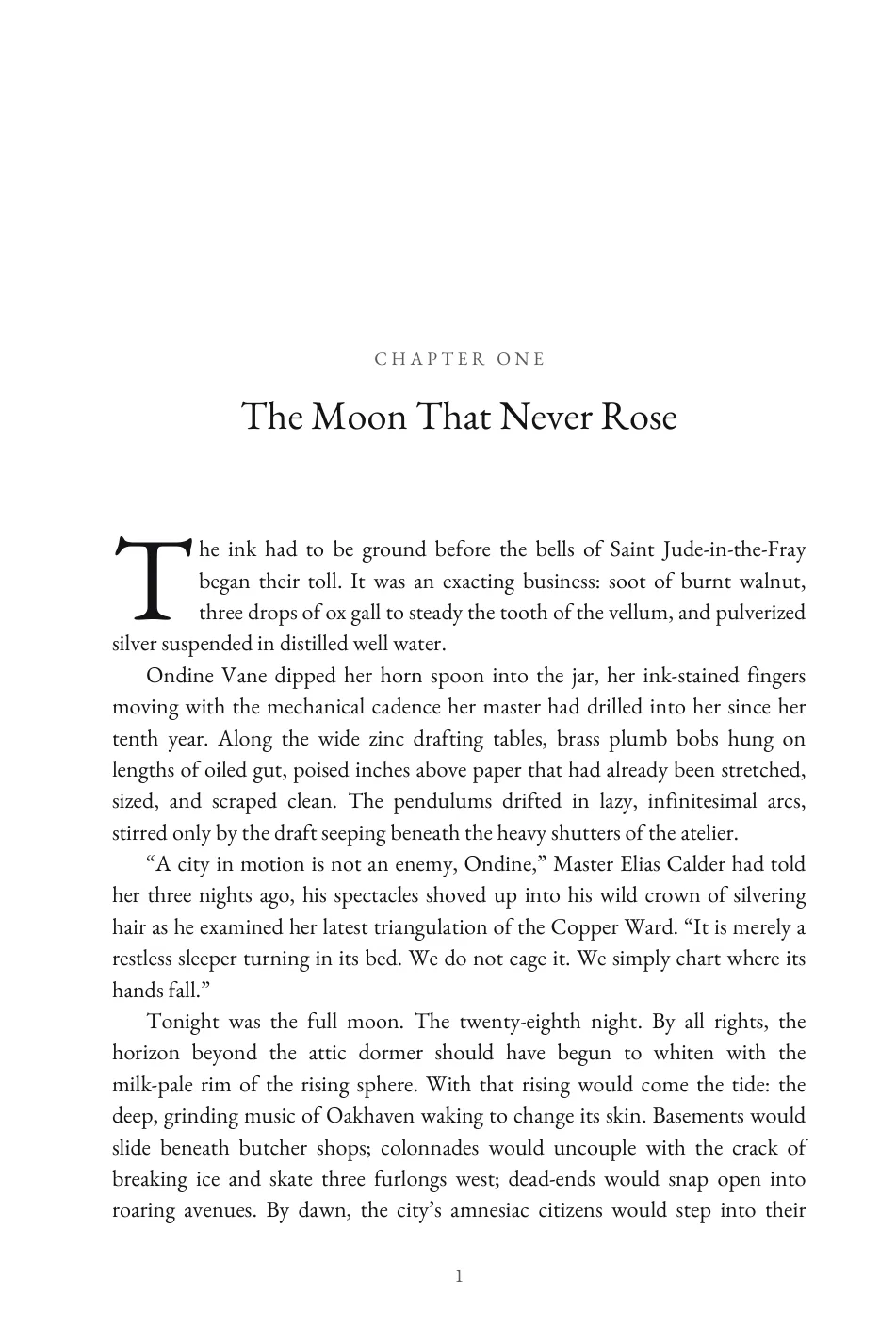
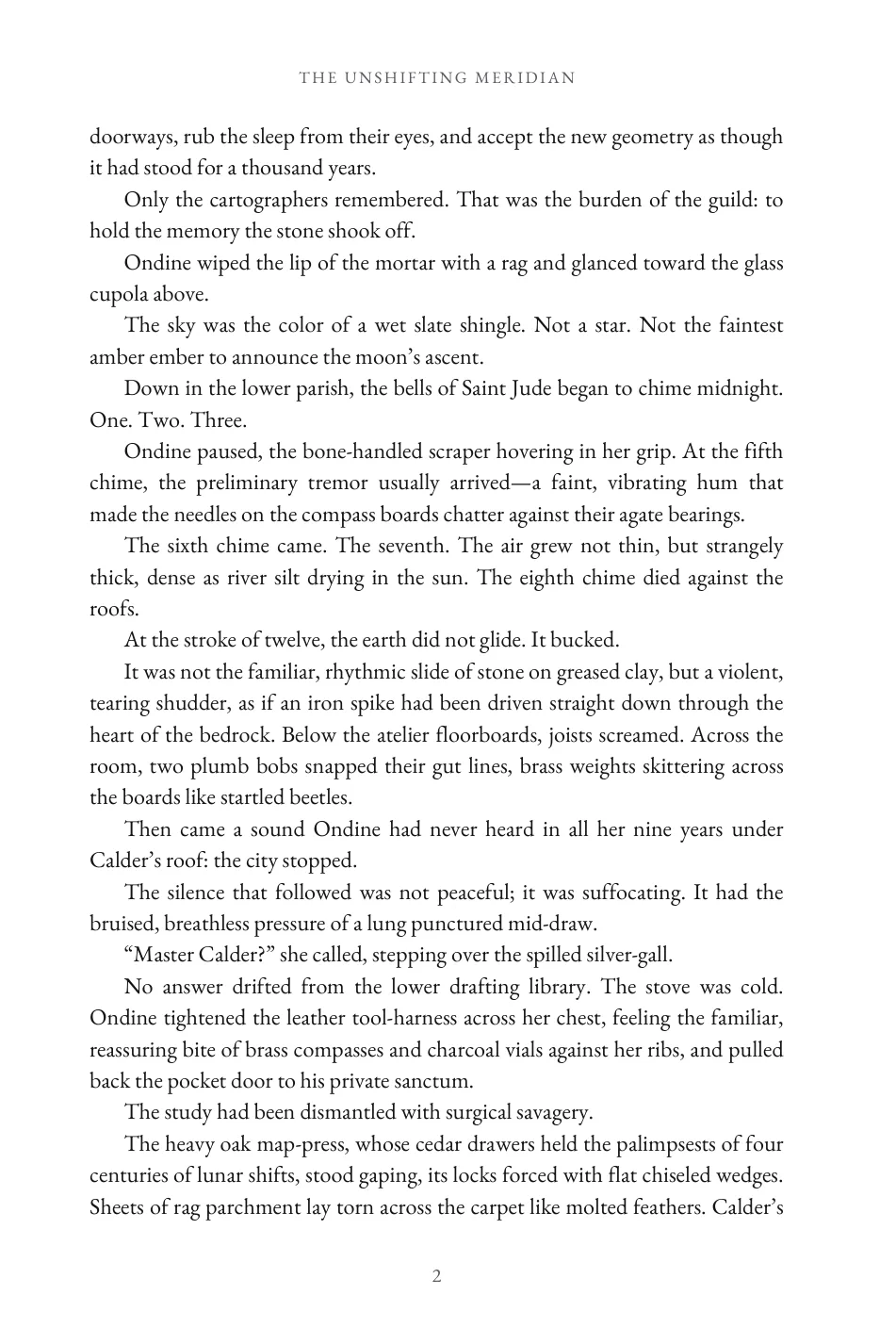
Pages from the print PDF of the same chapter, before any editing.
Chapter by Chapter, Not One Prompt
Why the AI book writer works on one chapter at a time, and what it carries from one to the next.
The most common complaint about writing a novel with a chatbot is that it loses the thread: "characters forget what they did earlier, plot threads vanish or the tone randomly shifts", as Tom's Guide put it. Writing a book chapter by chapter, with the plan written down, is how the AI book writer keeps the story in one piece.
Every chapter is written from the same brief: your book's description, synopsis and details, the full character sheets, the chapter's own plan, and the first lines of the next chapter's plan so it stops in the right place. On top of that it gets what happened so far.
Chapter memory
After each chapter is written, the AI notes what happened and what changed. Later chapters read those notes; in a very long book the notes of the most recent chapters come first.
The end of the last chapter
The next chapter also reads up to the last 3,000 words of the one before it, so it picks up the scene instead of retelling it.
Character sheets
Names, voices, motives and arcs come from the sheets you approved, not from the model's memory of an earlier prompt.
Your instructions
Rules you set for every chapter (tense, point of view, chapter style) go into each request, along with your writing sample if you added one.
What a Book Costs with the AI Book Writer
Credits, not subscriptions to each feature. Prices as they are in the workspace today.
Every step that calls the AI is charged in credits before it runs and refunded if it fails. Typing, editing by hand, moving outline cards, the review's sample page and the print preview are free.
| Step | Credits |
|---|---|
| Basics, details (AI) | 1 each |
| A character (new, rewritten or edited with AI) | 1 |
| Outline | 1 per 4 chapters |
| A chapter | 1 per 500 words |
| AI editor request | 1 |
| Chapter image or cover | 2 |
| Book review | 5 per 1,000 words |
| Metadata | 1 |
| Print and ebook files | 60 per book |
| Distribution piece | 3 |
A 20-chapter novel, worked out
20 chapters of 2,000 words (40,000 words) and 5 characters:
- Basics and details
- 2 credits
- 5 characters
- 5 credits
- Outline of 20 chapters
- 5 credits
- 20 chapters × 2,000 words
- 80 credits
- The manuscript, written
- 92 credits
- Review, metadata, cover and print files
- 263 credits
- From idea to print files
- 355 credits
Rewriting a chapter costs the same as writing it, so budget for the chapters you'll redo. For comparison, the Basic plan adds 400 credits a month and the Premium plan 2,000. The review works on any plan for its credits; the print and ebook files and the distribution kit need Premium or Professional, or a credit pack that unlocks them.
Plans and chapter length
| Plan | Price | Credits | Longest chapter |
|---|---|---|---|
| Free | $0 | 20 every 30 days | 1,000 words |
| Basic | $9.99/mo | 400 a month | 2,000 words |
| Premium | $29.99/mo | 2,000 a month | 5,000 words |
| Professional | $99/mo | 10,000 a month | 5,000 words |
Is the AI book writer free?
You can start every book for free. The free plan gives you 20 credits every 30 days and lets you write one chapter per book, by AI or by hand, so you can plan a whole book and read its first chapter before you pay anything.
Chapter 2 and on need a paid plan or a one-time credit pack ($9.99 for 300, $29.99 for 1,500, $99 for 7,500, $199 for 16,000), which unlocks the matching plan's features while its credits last. There is no free unlimited version, and an account is required.
From Manuscript to KDP Files
What the AI book writer does after the last chapter, and what you still do yourself.
Story-AI doesn't publish your book for you. It gets the files ready, and you upload them to Amazon KDP or another store under your own account, keeping your rights and royalties.
Review
A line edit and proofread of every chapter with notes on what works and what to fix, each edit accepted or rejected by you, and an editorial letter on the whole book.
Metadata
Your blurb, subtitle, categories and keywords, ready to paste into the store's form, plus the copyright page, dedication, acknowledgments and author bio.
Print and ebook files
A print PDF at your trim size with chapter openings, running heads and page numbers, a paperback cover sized from your page count, an EPUB with its table of contents, and a 1,600 × 2,560 ebook cover.
Promotion
Posts for X, Instagram, TikTok, LinkedIn and Facebook groups, Amazon A+ modules, a press release and review requests that follow Amazon's review rules.
What you still do
- Read and edit the book; you are its author
- Get an ISBN (KDP gives paperbacks one for free) and set your price
- Tell KDP which parts are AI-generated when you publish
- Upload the files and check the store's print preview
AI Book Writer vs ChatGPT and One-Shot Generators
Three ways to write a book with AI, compared on what matters for a whole book.
Most ai book writing software falls into one of three groups. A chat assistant is flexible but keeps no plan; a one-shot generator is fast but returns one block of text; a chapter-by-chapter workspace like this AI book writer is slower to set up and built for finishing a book.
Chat assistant | One-shot generator | Chapter-by-chapter workspace | |
|---|---|---|---|
| Plan before writing | Only what you paste in | A single prompt | Characters and an outline you approve |
| Memory across chapters | The conversation, until it runs out | None | Chapter notes and the end of the last chapter |
| Editing | Ask again and copy | Generate again | Editor with suggested edits and versions |
| Length | One answer at a time | Usually a few hundred to a few thousand words | As many chapters as you plan |
| Publishing files | None | Rarely | Print PDF, cover, EPUB |
Looking at specific tools? Our comparison of AI story generators lists features and prices side by side, and says where we're the one writing it.
Who This AI Book Writer Is For, and Who It Isn't For
A good fit
- Novelists who want a first draft to shape, chapter by chapter
- Writers turning a short story into a longer book
- Authors with a half-finished draft in Word who want to finish it
- Self-publishers who need KDP-sized files and a blurb
- Anyone looking for an ai novel writer for fiction in one of 30 languages
Not a good fit (yet)
- Non-fiction: book mode writes fiction only for now
- Picture books where a character must look the same on every page
- Explicit content: intimate scenes fade out, as in all Story-AI stories
- A finished book without reading it: you still edit every chapter
Rights, AI Disclosure and Copyright
Story-AI's terms of service give you ownership of what you generate, to the extent the law allows. The law differs between countries.
In its January 2025 report the U.S. Copyright Office concluded that prompts alone are unlikely to make you the author, while your own writing, selection and arrangement can be protected. The more of the book you rewrite and shape, the more of it is yours.
Amazon KDP asks you to disclose AI-generated content (text, images or translations) when you publish, and doesn't require it for AI-assisted content, such as text you wrote and then edited with an AI tool. Read the current wording in KDP's content guidelines before you publish, since stores update their rules.
Rules checked on 2026-10-23.
AI Book Writer FAQ
Is the AI book writer free?
You can start for free. The free plan has 20 credits every 30 days and lets you write one chapter per book, so you can plan a book and read chapter 1 before paying. Chapter 2 onward needs a paid plan or a credit pack.
Can I import a draft I already started?
Yes: click Import in the box and choose a Word file (.docx). Your chapters stay as you wrote them, and the AI fills in the outline, the characters and each chapter's notes from the draft. It costs 1 credit per 3,000 words, up to 200,000 words. On the free plan, chapter 1 opens; a plan or pack opens the rest.
Do I need an account?
Yes. Every book is saved to your account, which is what lets you come back to it chapter by chapter. Sign-up is free, and the idea you typed is kept while you create the account.
Can AI write a whole book for me?
It can write every chapter of it, one at a time, from the plan you approve. What it can't do is decide what your book should be or read it for you: the best results come from checking each chapter and fixing it before you write the next.
How long does it take to write a book with AI?
The sample chapter above, about 1,250 words, took 46 seconds to write; longer chapters take longer. Setting up the basics, characters and outline takes a few minutes. Reading and editing is the part that takes real time, as it should.
How long can a chapter be?
Chapters are planned at 100 to 5,000 words. Your plan caps the length the AI writes: 1,000 words on Free, 2,000 on Basic and 5,000 on Premium and Professional. Chapters you write by hand have no such cap.
Does it remember earlier chapters?
Yes. After each chapter the AI writes a short memory of what happened, and later chapters read those notes, the character sheets, the outline and the end of the previous chapter. Read each chapter anyway: details can still drift.
Can I edit what the AI writes?
Every word. Type in the editor, ask the AI editor for a change and accept or reject each suggested edit, or regenerate the chapter: the text it replaces is kept as a version you can restore.
Can I sell a book written with AI on Amazon KDP?
KDP accepts books with AI-generated content as long as you disclose it when you publish and the book follows its content rules. The print PDF, paperback cover, EPUB and ebook cover from the publish step are sized for KDP's trim sizes; you upload them yourself.
Who owns the book?
You do, to the extent the law allows, as our terms say. Copyright protection for AI-generated text depends on the country and on how much of the book is your own work.
Which languages can I write in?
Books can be written in 30 languages, including English, Spanish, German, French, Portuguese, Japanese and Turkish. The workspace itself is in English for now.
What can't the AI book writer write?
No sexual content: romance, attraction and kisses are welcome, but an intimate scene fades out before anything sexual is described. If the AI refuses a request, the credits are refunded.
What should I do after the first chapter?
Read it, fix what's off, and check the outline card for chapter 2 before you write it. If the book is heading the right way, a plan or credit pack opens the rest. For ideas and titles first, try the story generator or the book title generator.